Sunday, July 29, 2012

Optimal Outcome Part 2


I hope everyone is enjoying their summers.  It is so hot around here, and I am still pulling out my shawl from time to time- in the air conditioning, not outside. :)
I just wanted to share another tip that I recently started to implement.  Anything to make our finished work look better!

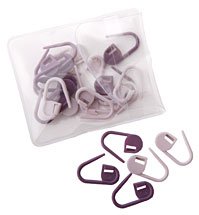
As I mentioned in this post, I am a row counter.  I also am a locking stitch marker addict (more on that later!) and use them religiously to keep track of increases and decreases. 
Clover Markers

Knit PicksMarkers


 Does that seem like too much effort?  Maybe, but nothing is worse than trying to backtrack and figure out how to  make 2 pieces match later. Trying to count rows to match shaping on dark or intricate fabric is so hard.
I used to place my markers at the beginning of an increase or decrease row. 
The more shaping, the further in you need to go to find an unbroken column of stitches
If you look at a piece that has shaping elements- decreases, bind offs, or increases, such as a waist, underarm or collar, you will notice that it is jagged or slanted and hard to tell later where the adjoining row begins.
 
I now place my row marker about 10 sts in from the edge, on each shaping row. This way, as I continue to shape the piece, I can isolate a column of stitches far enough away from the edge that I can keep track of rows easily. 
   See how the straight line of markers is easier to count.
So simple, but  such a time saver later.  What do you do to make sure your pieces match?

Saturday, July 14, 2012

A Knitter's Daydream

Nantucket Island is the epitome of an American needlework paradise.  Nantucket is historically rich with traditions in crafts such as basketweaving, knitting, rug hooking, and  needlepoint.  It is no wonder that needlework legends Claire Murray and Erica Wilson chose to open their successful businesses on this gorgeous island. From the scent of the salty air intermingled with the  fragrance of  abundant  cottage garden flowers, to the breath taking views of the turbulent Atlantic Ocean, Nantucket is singularly inspirational. I would love to be there right now, relaxing and pulling  my knitting project out of my bag ...


Knitting in Nantucket


 Perfect summer weight yarn  Allegoro by Classic Elite  Verde Collection


Thursday, June 28, 2012

Rib and Bobble Vest, VK Early Fall 2012

The Vogue Knitting Magazine Early Fall  2012  preview is now online. I am always excited to get my first glimpse of a new issue, and this issue has some lovely pieces that would make great summertime knitting projects.
VK Early Fall 2012

   I designed and knitted  Garment # 21, the “Rib and Bobble” vest.  This vest is really a simple knit as there is minimal shaping, and the seed stitch edgings are knit at the same time as the vest, so there is almost no finishing at the end of the project.  Much of the vest is knit in stockinette which is perfect for an “on the go” project.  The waist area ribbed section looks far more complicated than it really is!  The yarn I used was Blue Sky Alpacas Sportweight, and it is so soft.   

Rib and Bobble Vest    Vogue Knitting Early Fall 2012, photo by Rose Callahan


My vest is shown as part of a feature on  “twin sets” and it is paired with a turtleneck designed by the brilliant and multi -talented Lori Steinberg.  I love her juxtaposition of delicate and bold geometric openwork patterns.  I always find that "longer" short sleeve length to be very flattering, and I think that the ribbed turtleneck provides a nice contrast to the airy lace.
#24  Lace Turtleneck Vogue Knitting Early Fall 2012, photo by Rose Callahan
Don’t be afraid of the bobbles. They are not difficult, and add such wonderful texture.   I used my favorite variation in this pattern- really more of a popcorn than a bobble.  I find this variation is the easiest for most knitters as the bobble is completed immediately instead of on the next row.  Because the loops are pulled over each other one at a time, it is easier than trying to knit through 5 loops at once.  
Thistle bobble design

As much as I love to knit heavy, complicated, stranded  wool sweaters, I like to have a lighter project to work on during the summer. Vests, like tank tops are great multi- season wardrobe boosters.  They are quick to knit,  use relatively little yarn, and are portable to knit.  Perfect for those stolen minutes at the beach or pool!
What are you knitting this summer? Please share- I’d love to hear!

Monday, June 11, 2012

Optimal outcome - Knitting Pieces that Match

Sometimes it is the easiest things that make a knitted project successful.

Have you ever tried to sew 2 pieces of knitted fabric together only to find that they don’t match, or picked up a piece of knitting and been unable to figure out where you left off?  Yikes.  

  I am  a confirmed row counter. Logically, it is easier to mirror the shaping on the back and front of a garment if you start decreasing or increasing on the same row.  The same goes for pattern elements like cables.   Keeping track of where you are is important enough in an easy pattern,  but is  imperative in a more complex one. And, trust me, “eyeballing” your work in progress will never give you a perfect measurement!   
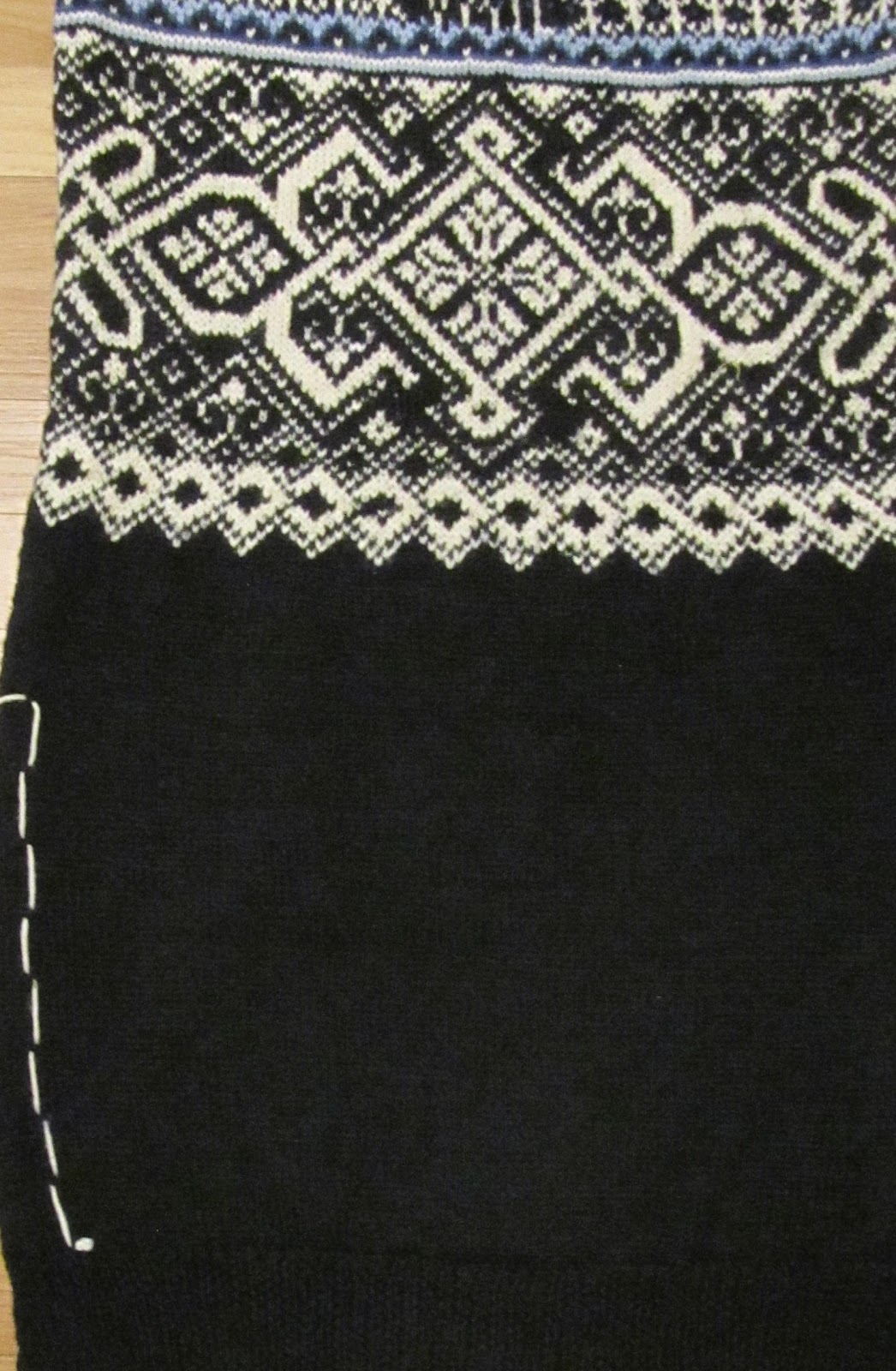
Unfinished Dale of Norway sweater . The white stitches on the left are "row counting" stitches.
   When I first started to knit, I remember using bulky cylinders with rotating numbers that fit on to the ends of straight needles.  The objective was to advance the number 1 time each time you completed a row.  The problem was, I could never remember whether or not I had actually turned the wheel at the end of the previous row! And, I could never get used to the feeling of having something hanging from the end of my needles.  The constant uncertainty and the fact that I have not knit with straight needles in years led me to try other methods.  I have a very methodical friend who carries a memo pad and writes tally marks down for each row.  I know knitters who swear by the invention of another friend, the row counter bracelet.*


Basting to mark your stitch count
    Simple basting works the best for me.  I use a large tapestry needle and a piece of smooth mercerized cotton yarn that contrasts in color with my knitting. Cotton will usually not leave fibers behind and “shed” onto my knitting.  I try to use a light color for visibility, and colorfastness.  I actually often keep the basting thread in when I wet block my work, although of course I would be careful not to leave strong cotton  in if my work was fuzzy, felting or delicate!  I attach the yarn at the bottom of my work and use a large tapestry needle because the blunt tip helps minimize the risk of pulling and split stitches. I use the tip of my needle to count up 10 stitches, and run a stitch under the 10th stitch. 
Each line indicates a group of 10 rows
    I continue in this manner until I am finished counting.  When I am finished basting, I always re count to confirm that I have blocks of 10.   Even though this may seem like an added step, at least I always know that the underarm will be in the same place on the front and back of a garment, and that the sleeves will be the same length.  (Don’t ask me how I know this!)  
    Since I always have a tapestry needle in my knitting bag, it is easy enough to do. And, when you unearth that unfinished object you had forgotten about(blushing!)it is much easier to continue if you know exactly where you left off.  How do you keep track of your stitches?

Wednesday, May 16, 2012

A Knitter's Daydream


Lysoen was the summer residence of famed violin virtuoso Ole Bull.
Knitting in Art by Annemor Sundbo at Schoolhouse Press
Dale Falk yarn at Woolybaabaa   
*Syttende Mai, May 17th is the day Norwegians celebrate the signing of their constitution. 

Saturday, May 12, 2012

Just in time for Mother's Day!

Happy Mother’s Day everyone! 
 I was really excited to get a surprise in the mail the other day.  It contained my copy of 60 More Quick Baby Knits, published by Sixth and Spring books. 
Photographed by Jack Deutsch
 I have 3 designs in the book.  I couldn’t wait to peek.  I love to see how the garments look photographed, and I always love the way the pictures are styled.  It takes quite a bit of time from the time I submit the garments until the books are published, so I always feel like I am looking at the sweaters for the first time.  I LOVE knitting for babies,and my boys are well out of the baby stage so this project was so much fun.  Baby clothes are a terrific way to try out new techniques, or new yarn without spending too much time or money.  I have to say I was so pleasantly surprised with the Cascade 220 Superwash sport yarn that was used in the book, that I tried to track some down recently for another project.  The colors were rich and varied, and the yarn had a smooth, almost cottony feel. None of these sweaters would ever make a baby feel “itchy".  My patterns are #29 Apple Tree Sweater, #32 Parisian Cardigan, and #46 Argyle vest.  
Photographed by Jack Deutsch
 The Apple Tree sweater and the Parisian Cardigan both have some duplicate stitch embellishment, which is an easy way to liven up plain stockinette. The Parisian Cardigan has a Peter Pan collar.
Photographed by Jack Deutsch
 The Argyle Vest is actually not constructed as a “true” argyle which is intarsia knit with bobbins. Instead the diamond pattern is made in a fair isle technique so that there are only 2 colors used in each row.  Much simpler.  I also deliberately placed a few plain stitches in between the front and back of the vest, so that extra stitches could be added to increase the width, without having to worry about the continuity of the argyle.
Photographed by Jack Deutsch


 Do you enjoy baby knitting? Let me know- I'd  love to hear about your tiny projects!